

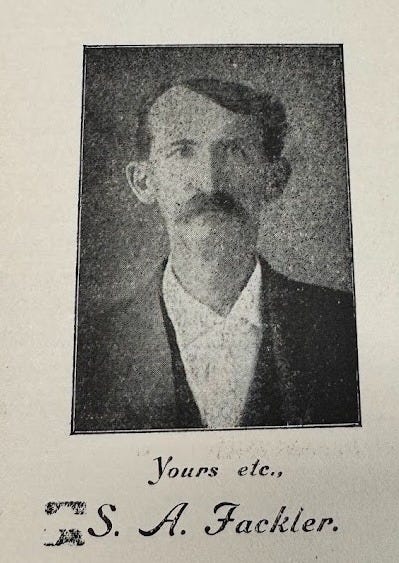
It was about this time last year that I first came across this story while doing research for my book about the history of early American newspapers at the American Antiquarian Society (AAS). It comes from one of the rare books in their collection, Ups and Downs of a Country Editor—Mostly Downs, written by a fellow named S.A. Fackler.
You won’t find this book online; as far as I know, the AAS has one of the only surviving copies, but it’s a wonderful little first-hand account of a life lived at the margins of the nineteenth-century newspaper trade. The book is brimming with stories about his misadventures as a tramp printer—moving from town to town, starting up newspapers, drinking too much, occasionally getting into fights, and generally leading a full and ribald life.
But there was one passage at the end of the book that has really stuck with me. The anecdote didn’t quite fit with my book, but I’ve been wanting to do something with it ever since—and, well, this seemed like the right time of year.
It was Christmas Eve, and Fackler had fallen on hard times. His wife had left him, and he was left to wander the Alabama countryside in search of work with his two little boys Bob and Willie. They were penniless, with nothing to eat and nowhere to sleep. Fackler had faced hard times before, but nothing like this.
In better times, Fackler had made sure Santa always brought his boys something for Christmas: new clothes, toys, confections, and so forth. But this year was going to be different, and he knew he would have to explain it to the boys in advance.
“Boys, this is one Christmas Eve night that Santa Claus will not visit you.”
When his younger boy Bob asked why, Fackler had to fudge it, explaining that because they were traveling Santa would have trouble finding them. Moreover, in years past he would leave money for Santa Claus to buy them gifts. But this year he was in no position to reimburse the jolly old elf.
“You see, papa has had no work in quite a while, so he has spent all of his money.” But he assured them that soon as he found a paying job, he would make up for it and buy the boys all kinds of nice things.
Little Bob was having none of it.
“Papa, it didn’t make any difference where we are at. You said that Santa Claus couldn’t find us way up here. Well, can’t God tell him where we are and don’t God tell him to visit poor children that can’t pay him?”
Fackler was stumped. But this wasn’t his first time living close to the bone. He was a lifelong tramp printer and roving country editor. Men like him were the shock absorbers of the nineteenth-century newspaper trade—moving from town to town, job to job, keeping presses running wherever they could, often spending their wages at the nearest saloon, and rarely staying long enough to build a safety net. When the work dried up, it was time to move on.
But most tramps were bachelors. Until recently, Fackler had abandoned that life and managed to build a family, with a wife and two boys and a house and all that entailed. Now the wife was gone, the house was sold, and he was dead broke again—walking down the road with his two little boys in hopes of finding somewhere to stay the night.
Bob continued his lecture.
“Yes, sir, Willie and I pray every night, and God is going to tell Santa Claus where we are.”
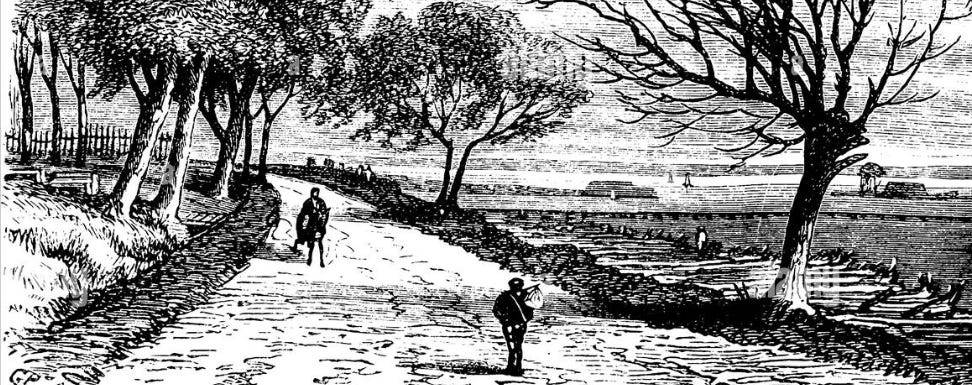
Fackler didn’t have the heart to tell him otherwise. So the little troop continued trudging along, making their way across the dirt roads until they came to a little settlement about eight miles outside of the town of Eufaula.
There, a man stepped out into the road to greet them. He was a farmer, and invited them into the farmhouse to rest for a spell. There they met the farmer’s wife (alas their names have been lost to posterity).
“They were good Christian people,” Fackler later recalled. The man and his wife offered them supper and invited them to stay for the nigh. The farmer’s wife even took the boys’ socks from them, washed them, and darned the holes that had long since worn through the feet.
That night, before bedtime, the boys took their newly repaired stockings and quietly hung them up in a nearby room, hoping against hope that Santa might yet find his way to them. All three of them went to sleep, bone tired but grateful to be sleeping in a bed for a change.
The next morning, Fackler woke up to the sounds of two shrieking little boys.
“Papa, oh, Papa!” Bob cried out. “I told you that old Santa Claus would find us, and God would tell him where we would be.”
Sure enough, Santa had found his way to the boys after all. Their stockings were full.
“Now, papa,” said little Bob, “didn’t I tell you yesterday that God would tell Santa Claus where to find us?”
Fackler nodded, duly chastened. “Well, boys,” he said, “I am glad he found you, for you surely had more faith than I had.”
That same day the farmer brought Fackler into town, where he managed to find work—on Christmas Day, no less—and earned a little bit of money, with which he promptly bought fireworks and a few pieces of candy for the boys. “So they had a jolly Christmas after all.”
Postscript
You may be wondering what became of poor Mr. Fackler. Well, I’m happy to report that he kept working that job in Eufaula for the next three months, saving up a bit of money, and managing to swear off the bottle for a time. There was an alcohol dispensary in town, and he claims never to have visited it once during his time there.
Fackler eventually moved on to Florida with his boys, where he found the time and energy to finish writing his memoir. He continued to have his ups and downs—and, yes, eventually found his way back to the bottle. But he had found a way forward, and the kindness of the farmer couple stayed with him always. Eventually he published his book, found steady work again, and even created a theatrical version of the book, leading a troop of players around Georgia to re-enact some of his memorable adventures.
But like most tramp printers, Fackler has been long forgotten. I offer this little vignette in hopes that it may yet find some of the readers he once hoped to reach.❦
Love this story! And love the antique print.