

We’ve all seen them: the weird cartoon explainers, cringe-inducing history videos narrated by synthetic voices, and recycled Wikipedia paragraphs swamping our social media feeds over the past year or so. Huge swaths of the Internet are now fully awash in AI slop. Perhaps Cory Doctorow is right that we’re all at risk of turning into reverse centaurs.
But this isn’t the first time people have had to contend with a flood of dubiously sourced drivel masquerading as news. In fact, editorial “slop” has been a proven business model for nearly two centuries now.
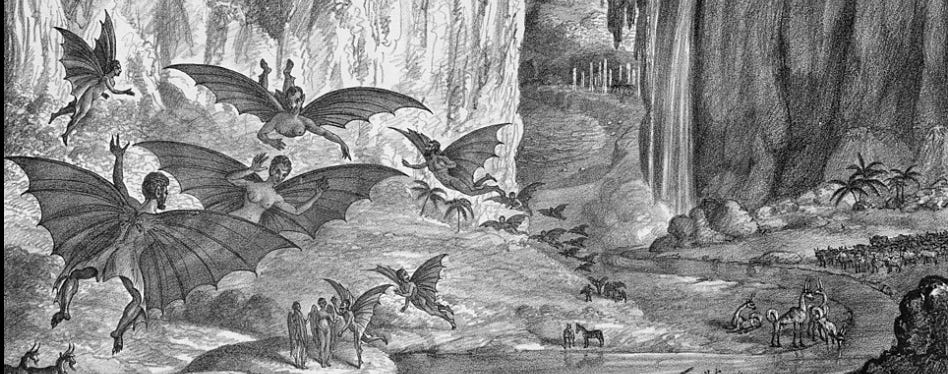
In the summer of 1835, The New York Sun—then a scrappy upstart penny paper—published a six-part series claiming that astronomer John Herschel had discovered life on the moon. He claimed to have used a super-powered telescope to spot bat-winged humanoids, sapphire forests, and unicorns cavorting across the lunar surface.
It was, of course, a bald-faced fiction. But the public ate it up. Soon, the story was popping up in newspapers all over the country. Indeed, The Sun’s editor Benjamin Day had conceived the whole thing as a prank, hoping to prove just how gullible his fellow newspaper editors could be in the face of a story guaranteed to boost circulation. Most of them reprinted the story without attribution, claiming it as their own.
Day and his fellow penny-press purveyors—like James Gordon Bennett of The New York Herald—essentially invented the modern attention economy. Their papers trafficked in scandal and sensation (and often outright falsehoods) that were widely reprinted across the loosely coordinated exchange networks that connected the nation’s newspapers in the nineteenth century. And their business model proved wildly profitable—for a while.
The Victorian heyday of newspaper proto-slop included tales of “science wonders”— fantastical inventions like perpetual motion machines, lightning-powered engines, and electrical devices that could cure paralysis or control the weather—and earnest-sounding stories that breathed life back into ancient myths: gentle giants, wild men, magical rocks, or sea monsters roaming up and down the eastern seaboard.
But it wasn’t the fictive nature of these stories that made them “slop” in the contemporary sense. Back then—in an age before modern journalistic standards had taken shape—the lines between fact and fiction were often blurred in the pages of newspapers. And a good deal of the material that recirculated through the nineteenth century media ecosystem was more-or-less true: recipes, trivia, bits of homespun wisdom, and any number of other “squibs” that regularly made the rounds across the exchange networks.
For many publishers, their overriding priority was simply to fill up space. And to do so they gobbled up as much of this kind of “evergreen” material as possible, passed from paper to paper, lightly rewritten, and then reprinted again whenever an editor needed to pad out a few column inches to round out the week’s edition.
The material was, for the most part, harmless. Readers enjoyed the stuff, editors depended on it, and no one really suffered. The “hard news” that appeared elsewhere in the paper remained mostly intact.
These stories ranged wildly in terms of quality, subject matter, and length. What bound it all together was its uncertain provenance. As Ryan Cordell and others have argued, this material functioned, in effect, as a kind of analog large language model: aggregating content from a number of different sources, synthesizing it, reformatting it, and recirculating it in new permutations. Nineteenth century newspapers were, as he puts it, “the largest text generation platform in human history.”
Like today’s AI explosion, the nineteenth century slop boom owed to several causes, only some of them technological. Literacy rates were rising, copyright protections were loose, and production costs were declining. As a result, thousands of newspapers could make hay recycling each other’s content, making slight modifications along the way, and passing it off as their own. The economics of the market rewarded speed, efficiency, and reuse of already-proven, readily available editorial content.
Nineteenth century newspapers perfected the art of turning editorial scraps into news-shaped noise. Today’s AI slop is simply the latest manifestation of this early-industrial attention economy.
What can we learn from the slop of yesteryear?
First and foremost: everyone likes a good story, whatever the source. Non-journalists often care more about whether something is engaging and entertaining than whether it is meticulously sourced (especially when it comes to lighter fare). But the history of the penny press and the exchange networks also remind us that the economics of cheap content production don’t scale indefinitely.
The rise of Victorian slop wasn’t a moral failure on the part of editors; it was a rational response to a market that, for a time, created economic incentives that rewarded this kind of cheap recycled content. But eventually that logic collapsed under its own weight—forcing the press to undergo a painful period of self-examination and reinvention (a much bigger topic that I’ll save for another post).
Similar dynamics apply today. As Shuwei Fang argues, we’ve entered an era of “liquid content,” where stories are endlessly remixable, trivially reproducible, and increasingly detached from the notion of a stable, individually authored artifact. Once the marginal cost of production drops to near zero, however, the value of the individual artifact plunges.
AI slop won’t disappear anytime soon (however much the social platforms claim to be making efforts to suppress it). It’s the predictable result of a system optimized for attention, throughput, and monetization. But that logic will eventually falter. If the nineteenth century offers us any comfort, it’s that slop eventually eats its own tail.
Just as The Sun eventually drowned amid a host of cheap imitators—paving the way for new, higher-quality newspapers to emerge later in the century—today’s deluge of AI-generated detritus may yet yield to new norms and standards for transparency, verification, and journalistic craft.
To paraphrase Fang’s argument, the future won’t belong to those who produce “buckets”—volumes of cheap content—but rather to those who build pipelines—the systems, structures, and practices that deliver meaningful journalistic value rather than adding to the noise.
Personally, I remain hopeful that today’s vast reservoir of slop will become the petri dish from which new forms of meaning-making will emerge. But for now, that’s a story still waiting to be told.
For anyone interested in digging deeper, here are a few of the sources I drew on for this piece:
• Cory Doctorow on “reverse centaurs” and the current AI slop ecosystem:
https://doctorow.medium.com/https-pluralistic-net-2025-12-05-pop-that-bubble-u-washington-8b6b75abc28e
• Shuwei Fang on “liquid content” and the economics of pipelines vs. buckets:
https://radicallyinformed.substack.com/p/beyond-the-artifact-the-brutal-economics
• Ryan Cordell on nineteenth-century exchange networks and text generation:
https://ryancordell.org/research/scissors-paste-LLMs
• More on the 1835 Moon Hoax:
https://en.wikipedia.org/wiki/Great_Moon_Hoax
Happy to add more if folks have recommendations.