

In 1893, a 23 year-old Savannah Times reporter named Robert (“Bob") Martin moved his young family to Hinesville, Georgia. There, he planned to strike out on his own. While still writing stories for the Times, he plowed most of his savings into buying a small local paper called The Hinesville Gazette.
The Gazette’s previous owner, Samuel Bradford, was a retired Civil War captain and former school principal who also put out the local paper with a Washington Hand Press and a one-of-a-kind, cobbled-together job press that one contemporary described as a “freaky little machine.” It was the only machine of its kind in the world.
Bob Martin bought out the whole operation, changed its name to The Liberty County Herald, and proceeded to put out the paper every week for the next forty years.
That man, Robert Martin, was my great-grandfather.
I never met him. But I knew his sister, Stella Rimes. My great-great Aunt Stella followed her brother into the trade, working for a time at the Herald before striking out on her own to start her own paper in a small nearby town: The Ludowici News.
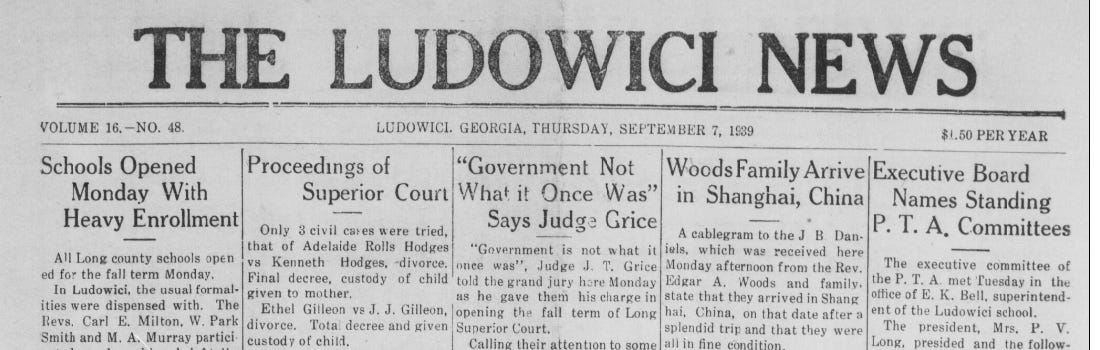
For most of the next fifty years, Aunt Stella wrote, edited, and published the paper. I can still summon childhood memories of sitting on her porch on a hot summer Georgia night, eating dates and watching the fireflies dance under the Spanish moss, listening to her reminisce about her days sticking type in a country printshop.
As I grew older and made my way into the working world—including stints in both old and new media—I occasionally wondered about this part of my family’s lineage. All we really knew of the Martins came down to a few fragmentary recollections shared over boiled shrimp and black-eyed peas at the odd family reunion in Wrightsville Beach.
As my parents' generation gradually passed on, the family lore dwindled even further. Somehow no one had managed to hold on to any surviving copies of any of the family newspapers. I’m grateful to the Digital Library of Georgia, who have managed to salvage and digitize a few scans of the Ludowici News. But to this day, I have yet to track down a single copy of the Liberty County Herald. The one time I journeyed to Athens, Georgia, to track down the one known edition at the University of Georgia library, it was nowhere to be found. So I was left with little more to go on than my own curiosity about whatever it was old Bob Martin might have been writing about all those years.
In hopes of conjuring up a version of this world for myself, I started sketching out a novel set in an 1890s country newspaper. It seemed like a ripe setting, at a time when newspapers were exploding and new technologies were transforming the publishing landscape. But the more I started going down this path, the more I found myself pulled down the rabbit hole of American newspaper history. Eventually, I found myself writing an altogether different book.
That book, Empire of Ink, is coming out next week from Basic Books. It represents about 15 years of research and writing (with more than a few detours along the way into starting a family, working assorted jobs, grad school, and such). But ultimately, what started as an archival query has morphed into a journey through the strange and glorious world of nineteenth century newspapers.
Along the way, I discovered that the story wasn't so much about newspapers as it was about the people who made them.
In the coming weeks, I’ll be sharing a few characters from the book that have stayed with me: people like Mary Katherine Goddard, the revolutionary printer who gave physical form to the Declaration of Independence; Sequoya, the Cherokee polymath who invented a written language and gave his people a voice in the public debates that would decide their future; Nellie Williams, the precocious eleven-year-old who supported her family during the Civil War by publishing her own wildly successful weekly newspaper; and George Joslyn, the self-styled "cornpone sheikh" of Omaha who built his patent-medicine business into a Gilded Age fortune. Along the way, we also encounter a few familiar figures, like Benjamin Franklin, Frederick Douglass, Amelia Bloomer, Joseph Pulitzer, and Mark Twain.
There’s much more to tell, and I hope you’ll join me along the way.
Can't wait to read about more characters in the book! Huge congrats on your book coming out in a few weeks... it's been quite the journey. ;-)
You are always a joy to read, congrats on what sounds like a fascinating book.