

This weekend I had the chance to spend a couple of days in Nashville at the Southern Festival of Books, where I got to bask in the company of various Book People and had a great chat with local newshound Steve Cavendish.
Today, Nashville’s newspaper landscape looks like so many other mid-sized cities: a struggling daily, a few promising non-profits and scrappy start-ups like the reconstituted Nashville Banner, as well as the widely respected Tennessee Tribune (the only state-wide Black-owned paper in the country).
It was not always thus. For much of the twentieth century, Nashville supported two thriving competing dailies: the morning Tennessean and the afternoon Nashville Banner. The latter closed its doors in 1998 after more than 120 years in print.
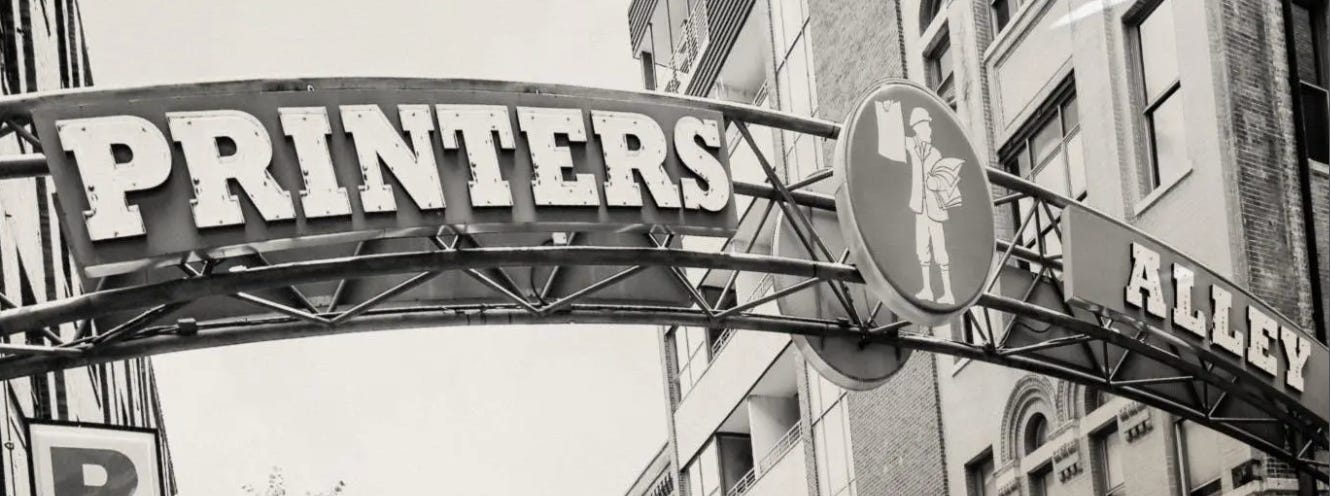
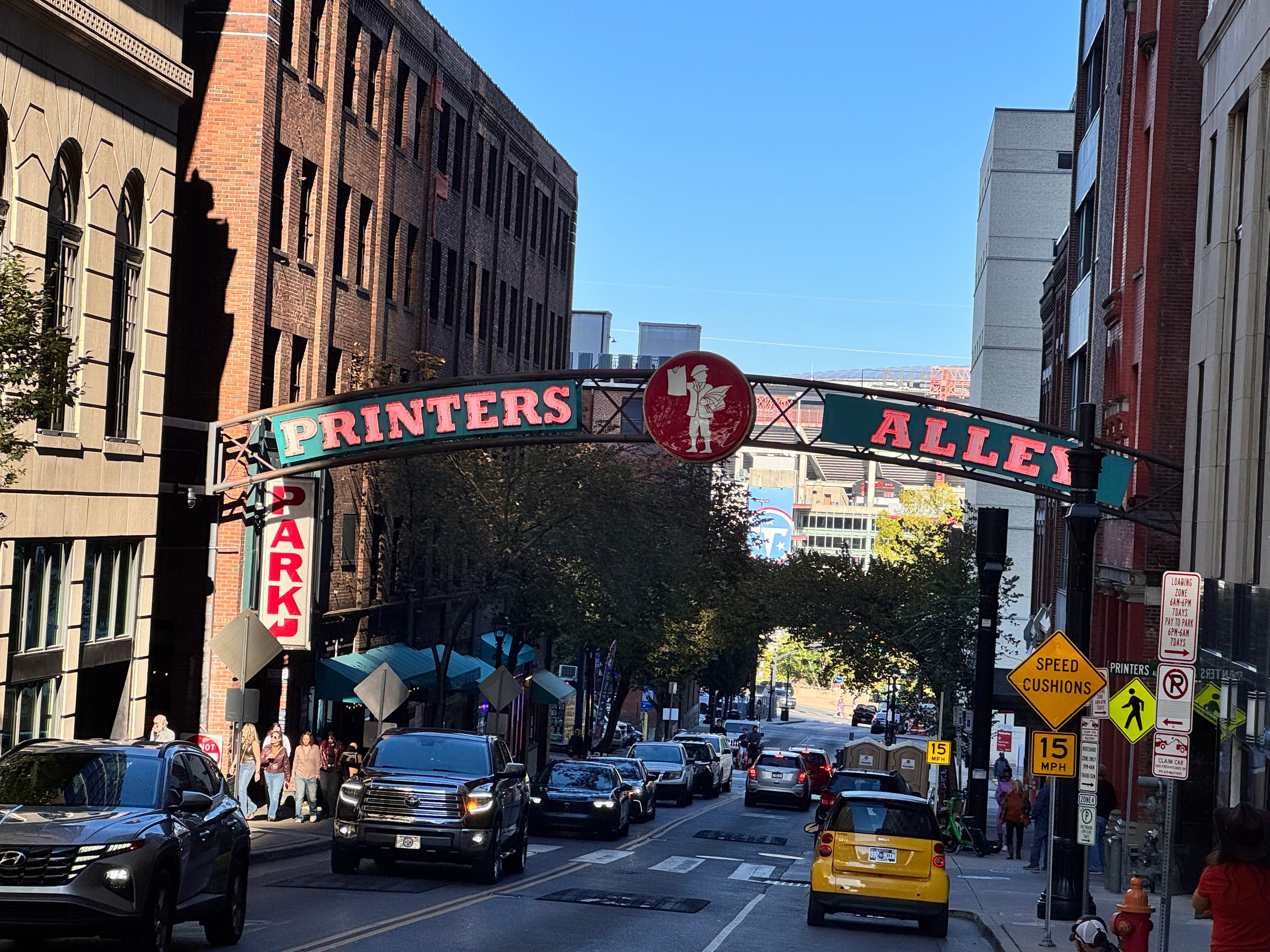
Today, Nashville’s Printer’s Alley is better known for its honkytonks and brewhouses than for its printing presses. But a century ago, the neighborhood was home to ten different print shops, thirteen publishers, the offices of both major newspapers, and a slew of smaller competitors like The Nashville Globe, The Independent, and the Daily American. Beyond the city limits, some 300 other local papers flourished across the state, staffed by hardscrabble editors, tramp printers, and a host of mostly forgotten scribes. Scratch below the surface, and you find a state whose history is steeped in ink—and, sometimes, blood.
For devotees of the 19th century press, Tennessee also occupies a special place in literary history by way of Mark Twain’s famously bombastic short story “Journalism in Tennessee.”
The tale follows a greenhorn reporter who arrives at the offices of The Morning Glory and Johnson County War-Whoop. On day one, his grizzled, cigar-chomping editor assigns him the task of writing a story on the “spirit of the Tennessee press.” When the narrator dutifully assembles a column stitching together a handful of sober-minded news items about local elections and some upcoming railroad and road-paving work, his editor flies into a positive rage.
“Thunder and lightning! Do you suppose I am going to speak of those cattle that way? Do you suppose my subscribers are going to stand such gruel as that? Give me the pen!”
The editor rips up the column and proceeds to get to work, punching up the copy in rather dramatic fashion:
“That ass, Blossom, of the Higginsville Thunderbolt and Battle Cry of Freedom,” “the besotted blackguard of the Mud Springs Howl,” and “that mustard-plaster of a newspaper, the Daily Hurrah!” and so on. “Now that is the way to write—peppery and to the point.”
The editorial mayhem is soon punctuated by actual bullets flying through the window and a hand grenade launched into the office by an offended rival editor. When a colonel storms into the office brandishing a revolver to settle the score from a prior insult, the editor calmly shoots him. The colonel, now mortally wounded, takes his leave “with fine humor, that he would have to say good morning now, as he had business uptown. He then inquired the way to the undertaker’s and left.”
Finally the editor decides to call it a day and instructs his new charge to deal with a list of incoming enemies. “Jones will be here at three—cowhide him. Gillespie will call earlier, perhaps—throw him out the window. Ferguson will be along about four—kill him. That is all for today, I believe.”
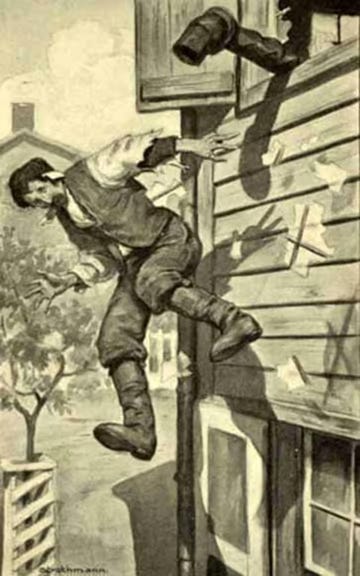
Though wildly exaggerated for comic effect, Twain’s satire was firmly grounded in reality. Newspaper offices were often the site of violent conflict—especially in the South in the years leading up to the Civil War. Dueling editors, offended politicians, and occasionally enraged readers turned the mid-century printshop into a proving ground for ideology, regional identity, and masculine honor.
The fire-breathing, gun-wielding editors of the nineteenth century make today’s online keyboard warriors look like hopeless milquetoasts.
Veteran newspaper editor Lambert Wilmer reckoned that “more duels have been fought, in this country, by public journalists than by naval and military officers.” An English traveler named Frederick Marryat observed that “the majority of the editors of the newspapers in America are constantly practicing with the pistol, that they may be called upon when ready, and are most of them very good shots.”
The rise of dueling among American editors owes much to the ancient European tradition of the code duello—a code of honor among the noble classes that gained considerable traction in the first half of the nineteenth century. America had no formal noble class, but for the self-made editors and politicians who made up the country’s new governing elite, the code duello seemed like a path toward claiming legitimacy and influence.
Nowhere was the code duello more famously on display than in the Hamilton-Burr duel of 1804—a contest whose original casus belli was, naturally, a newspaper article.
During the partisan press era of the first half of the 1800s—when political parties often funded newspapers directly—many editors began to see themselves as politicians in their own right, using their papers to goad rivals into rhetorical—and physical—combat.
Andrew Jackson’s populist election in 1828 added fuel to the fire, as editors increasingly saw themselves as fighters—“knights of the quill”—locked in a pitched battle for the country’s future. The editors of this era made no pretense at neutrality or objectivity; they were loyal soldiers of their respective causes. As political dividing lines widened and party loyalties solidified, many editors felt compelled to make a public showing of both their political bona fides and their manly courage.
Hot-blooded editors thus often exercised two of their constitutional freedoms at once: the right to free speech and the right to bear arms.
Historian Ryan Chamberlain argues that the culture of newsroom violence in the antebellum era has often been overlooked and underestimated—or, if acknowledged at all, reduced to a handful of colorful anecdotes. But the reality is that duels, gunfights, fisticuffs, and mob violence were a shockingly regular feature of newspaper life at mid-century.
That trend accelerated starting around the 1830s, a period that happened to coincide with a burst of new newspapers being established all over the country. The explosion of newspapers—fueled by territorial expansion, the subsidized postal exchange networks, and lowered barriers to entry thanks to advances in printing and papermaking—triggered an unprecedented social experiment. Although Northern states had started to crack down on the practice of dueling by the 1830s, the tradition persisted across the Southern states and frontier territories.
“In this new era of individuality,” Chamberlain writes, “the ritual of honor became a measuring stick by which the partisan newspapers promoted and detracted emerging politicians.” That culture of violence would continue to spiral into progressively more heated conflicts in the run-up to war.
Further south, in Vicksburg, Mississippi, the blood-soaked spirit of antebellum American newspapering loomed large. Between 1837 and 1860, the Vicksburg Sentinel cycled through no fewer than eight editors—five of whom met with violent ends.
The Sentinel’s founding editor, Dr. James Hagan, was an Irish immigrant with an outsized personality and—even for the times—an exceptionally caustic pen. He was by all accounts an incorrigible hothead, who at one point even pulled a pistol on a group of fellow train passengers for having the temerity to object to his opening a window.
As an editor, he was no less belligerent, a full-throated polemicist for the local Democratic Party who pulled no punches when it came to eviscerating their rival Whigs. Early in his career, he wrote a blistering editorial criticizing a local congressman named Hugh Stewart. Offended, the congressman tracked Hagan down in a local saloon and slapped him in the face. Invoking his rights under the code duello, Hagan challenged him to pistols at dawn.
Stewart refused, on the grounds of being a congressman and therefore loath to break the law. But Hagan took his refusal as an insult and began to escalate his war of words in the pages of the paper. At one point he called Stewart a “cowardly poltroon,” to which Stewart retorted—via a rival paper—that Hagan was an “infamous coward, scoundrel, villain, and slanderer.”
The torrent of insults continued and intensified, with Hagan calling Stewart “an ignorant and dastardly booby” and challenging him once again to a duel. Stewart refused a second time, but by this time Hagan had discovered that these editorial skirmishes were a boon to his business. Subscriptions were ticking up, as readers thrilled to the animal spirits on display. Hagan had found a winning formula.
Next Hagan set his sights on editor William H. McCardle of the crosstown Vicksburg Register and challenged him to a duel. This time his opponent accepted, and both men took to the field with murderous gusto. Hagan shot McCardle in the side and escaped without injury.
Over the next few years, Hagan continued to pick fights with rival editors and local politicians, enduring beatings, an attempted shooting, and a brief stint in jail. Finally in 1843, his truculent ways caught up with him when he got into a scuffle with a young man named Daniel Adams—the son of a judge whom Hagan had recently pilloried in print. The younger Adams tracked down Hagan, tackled him and wrestled him to the ground, then pulled out a pistol and shot him at point-blank range. Hagan died on the spot.
But his legacy would live on.
Hagan’s violent antics set the tone for the editors who succeeded him. His immediate replacement was a former schoolteacher named John A. Ryan. The rival editor of the local Whig, R. E. Hammett, welcomed the new editor to the fray with a provocative salvo: “Our new potato blossom over the way, whose sudden transition from the stool of the pedagogue to the chair editorial has given him imaginary importance.”
Ryan, feeling duly affronted, picked up the gauntlet and immediately demanded a duel. On February 29, 1844, the two met on the field of honor. Ryan lost, dying on the fourth shot. The Sentinel went on to grieve him as “the second martyr who has fallen in the cause of Democracy within the last year.”
He would not be the last.
Next up, a man named Walter Hickey took the reins of the Sentinel and soon enough found himself embroiled in a street fight with Dr. J. F. Macklin, shooting him dead in the scuffle. Hickey later absconded to Texas, where for unknown reasons he killed himself. His replacement, John Lavins, was imprisoned for repeatedly threatening violence against the subjects of his articles. The incarcerated Lavins was replaced by John Jenkins, who was promptly shot dead in a heated political argument. Jenkins’s partner F. C. Jones took the reins, only to die in a drowning incident soon thereafter.
In 1860, the Brooklyn Eagle published a column observing that “the Vicksburgh Sentinel (Miss.) wants an Editor.” The article went on to note wryly that “the Sentinel frequently wants an Editor.” Recounting the morbid fates of the men who had held that position over the past two decades, the piece further suggested that the particular history of the paper might tend “to account for the constant recurring vacancies.”
The man who next took up the call, a fellow named Roy, was—in the time-honored fashion of Sentinel editors—shot to death by an aggrieved reader.
And so at last the Vicksburg Sentinel gave up the ghost—leaving in its wake a trail of death, ill will, and a surrounding town numb to the sight of blood in the streets.
While Vicksburg’s fighting editors might have gotten themselves into skirmishes more often than most, they were scarcely the only editorial combatants spoiling for a fight. The pages of Southern newspapers from the 1830s to the 1850s brim with accounts of duels and other bloody conflicts—far too numerous to count. The disagreements were not just political; violence often erupted over topics as varied as debates over banking policy, skin plasters, Native American land claims, or any number of garden-variety personal insults.
And yet there was a method to the madness. As James Hagan had discovered, outrage could be good for business. A well-placed insult might provoke a rival editor, delight a partisan readership, and sell a few more subscriptions. The resulting controversy could then furnish material for the next edition. It’s a dynamic that would be familiar to anyone who can stomach the nightly shouting matches on cable news.
Here in Nashville, the presses of Printer’s Alley have long since fallen silent. But the fighting spirit of Twain’s Tennessee press—”peppery and to the point”—lives on.
Further reading:
Chamberlain, Ryan. Pistols, Politics and the Press (Jefferson, N.C.: McFarland, 2009).
Jones, Terry L. “The Perils of Antebellum Journalism,” Country Roads, March 21, 2022.
Twain, Mark. “Journalism in Tennessee.”
Wilmer, Lambert. Our press gang: or, A complete exposition of the corruptions and crimes of the American newspapers (reprint ed. New York:Arno, 1970).