

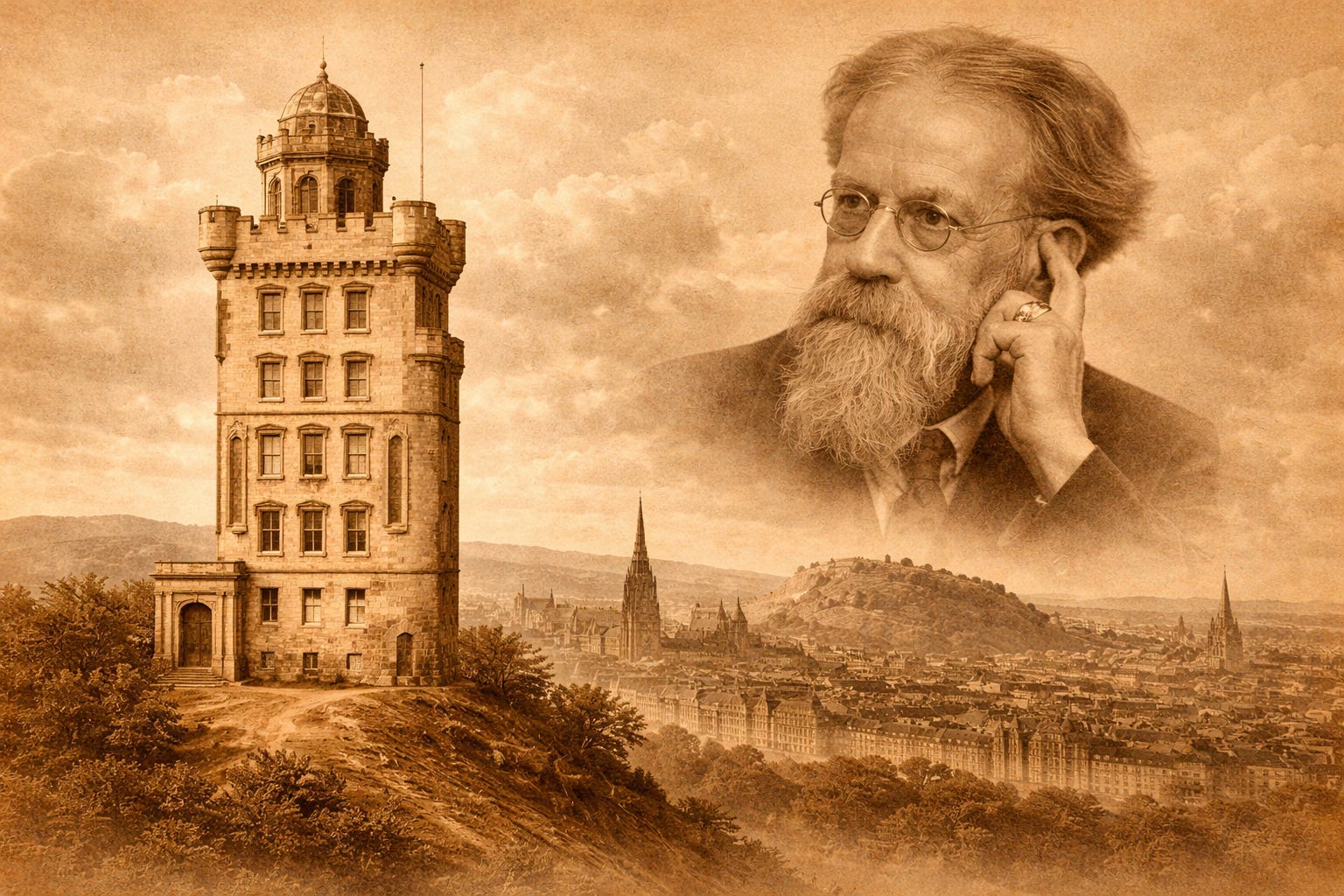
As a ten-year-old boy visiting Edinburgh for the first time in the 1970s, my mother took me one afternoon to a quirky tourist attraction: the Camera Obscura. You climbed to the top of a five-story building and stepped into a dark room. Someone opened the skylight, and suddenly you saw what looked like a live video feed of the street life down below. Except there was no electricity involved; the whole thing ran on light and shadows.
I was so taken with the experience that when I got back to my suburban middle school in Virginia, I decided to take a run at building a replica of it for my sixth grade science fair. My hokey attempt was essentially a cardboard box with a couple of holes poked through it. It barely worked. But the thing served its purpose, and somehow I managed to walk away with a second-place ribbon (an achievement that in hindsight feels more like a testament to the prevalence of baking soda volcanoes and balloon rockets than a validation of any particular scientific acumen on my part). Afterwards, I promptly tossed it in the trash and returned to my sixth grade life.
Fast forward a few decades, and I found myself back in the camera’s orbit.
It turned out that the original camera had been created by a fellow named Patrick Geddes in the 1880s (from an original design by Aristotle). Geddes, it turns out, was a close collaborator of Paul Otlet, a man I had already been researching and writing about for several years. Otlet too had once visited the Camera Obscura, and came away sufficiently intrigued that he set out to meet its inventor.
Otlet later recalled his first visit to the Tower: “As I stood, crammed with new knowledge, and upset by such sudden change in my ordinary ways of looking at things, Geddes pulled aside a curtain. ‘In here you may rest awhile.’”
Otlet and Geddes quickly struck up a friendship. They recognized each other as kindred spirits. Both thought deeply about the interconnectedness of human knowledge, and felt that the world was facing an epistemic crisis. There was too much information being produced, and not enough effort expended on trying to synthesize it.
Geddes saw his Outlook Tower as a first step in trying to address that problem. In its original incarnation in the 1880s, the Camera Obscura was just one component in a broader project that Geddes had conceived called the Outlook Tower. The camera sat atop a series of exhibits stacked on successive floors of the building, each featuring a display intended to inform them about the city and its relationship to the wider world.
“The general principle is the synoptic one,” Geddes wrote, “of seeking as far as may be to recognise and utilise all points of view—and so to be preparing for the Encyclopaedia Civica of the future.”
On the floor below the camera was an exhibit about the history of Edinburgh; on the floor below that, the subject was Scotland, followed by Europe, and then, finally, the world. On the ground floor was a darkened chamber outfitted with a single chair: the so-called Inlook Room, in which each visitor could reflect on what he or she had just learned.
The Outlook Tower marked Geddes’s first attempt at realizing what would become an all-consuming vision: to unite the world’s disparate branches of knowledge into a unified whole. Over his long and varied career he pursued that vision through books, speeches, and close collaborations with Otlet—who, like Geddes, believed that museums had an important role to play.
Geddes felt that the best way to shape the social mind would involve a new kind of teaching museum, designed to educate members of the public about their immediate environment and its relationship to the wider world.
He envisioned an institution devoted to presenting a unified overview of the intellectual world, arranged according to a master classification scheme inspired—like Otlet’s Universal Decimal Classification—by Positivist conceptions of a rational order to the sciences.
Embracing that synthetic view of human knowledge, Geddes imagined his new museum along the lines of an encyclopedia, in which the entries would be presented not in book form but mapped on a wall and displayed “as an orderly series of labels”: a kind of 3D interface, closely tied to a particular geographical location.
To ensure that the museum connected with each visitor at a personal level, he grounded each exhibit in locally observed phenomena, by presenting “universal classes of things and facts by displaying locally generated or found exhibits of these classes.”
In this way, the Index Museum would orient each visitor to a spectrum of human knowledge that was broad but always rooted in the immediate experience of the surrounding area.
Geddes’ dreams of a transformed city stood in stark contrast to the gritty reality of Edinburgh, where a massive influx of new arrivals from the country had left the city contending with desperate poverty, high infant mortality rates, and widespread illiteracy.
From high atop his new building, he saw the city he loved becoming engulfed in cheap housing, caked in dirt, awaft in smoke, and stewing in raw sewage.
But most Edinburgh residents steered clear of neighborhoods like the infamous Leith slums, a district of “squalid lanes and closes” that few people of means had any reason to visit.
Geddes, like other civic-minded reformers, took a broader view of the problem, arguing that the lives of all Edinburgh residents were inexorably intertwined, whether they liked it or not, and that the solution to the slum problem involved taking a more integrative and constructive view of city life.
He hoped to educate the public about a reality that many of them seemed disposed to ignore, and perhaps incite them to action.
The display in the tower would play a critical role in this transformation, functioning as an active force for social change rather than a mere popular attraction.
Like Otlet, he had been strongly influenced by Auguste Comte’s ideas about sociology as a tool for effecting change in the world, and of the importance of approaching the other “preliminary” disciplines—like biology, physics, chemistry, and mathematics—in the context of their relationship to human society at large.
These subjects “are not so purely abstract or externally phenomenal as their students have mostly supposed,” but are each and all of them a development of the social process itself.
Geddes’s work throughout his career anticipates what would later come to be known as systems thinking. He was less interested in discrete bodies of knowledge than in exploring the relationships between them. Knowledge, in this view, was not simply something to be accumulated, but something to be organized, navigated, and understood as a whole.
In that sense, he can be seen as a spiritual and intellectual ancestor of later thinkers like Donella Meadows, Gregory Bateson, and even Buckminster Fuller—who likewise emphasized the importance of seeing systems in their entirety rather than solely in terms of their parts. Geddes recognized that the whole is not only the sum of its parts, but that the elusive “whole” is itself a subject worthy of study unto itself.
And what of the Camera Obscura? It survives to this day, reimagined as part of an exhibit that includes a new so-called World of Illusions. It’s now one of those Instagrammable tourist spots—and from what I can tell, a far cry from Geddes’ and Otlet’s original vision of a world museum. Nonetheless, at the heart of the museum the camera still stands, peering out over the surrounding countryside, a lonely synopticon trying to help people make sense of the messy world around them.
Note: This essay is adapted in part from my book Cataloging the World. For a general introduction to Geddes, I also recommend: Philip Boardman’s The Worlds of Patrick Geddes (1978) and Murdo Macdonald’s Patrick Geddes’s Intellectual Origins (2020).
I so admire your writing style and your ability to merge biography with theory over the long duree! :) this I found so helpful! “The general principle is the synoptic one,” Geddes wrote, “of seeking as far as may be to recognise and utilise all points of view—and so to be preparing for the Encyclopaedia Civica of the future.”