

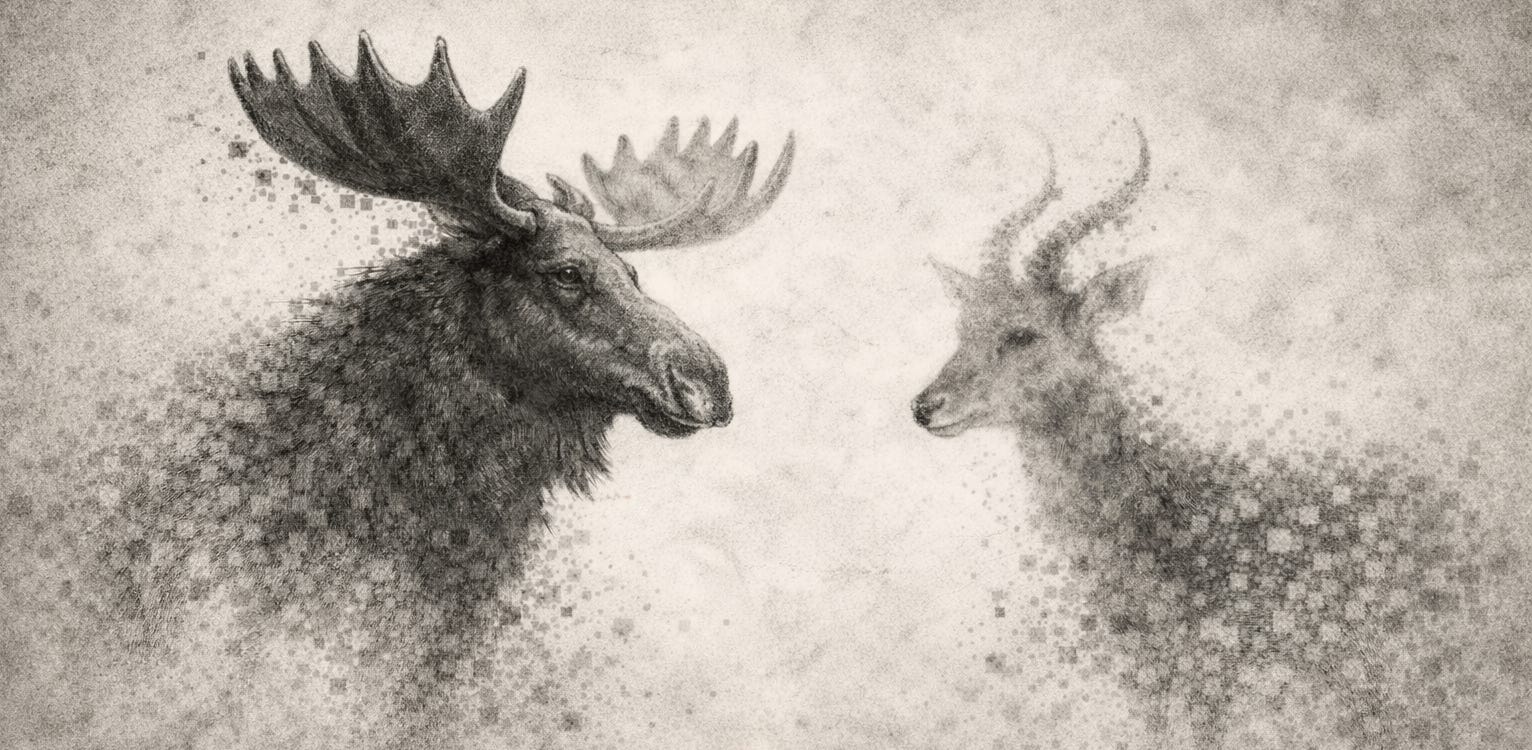
In 1951, a little-known French librarian named Suzanne Briet posed a simple question that still bedevils us today: When does anything become a fact?
To illustrate her point, she offered a playful example. Imagine a rare species of antelope, roaming free somewhere on the African savannah. It is wild, unrecorded, and not yet cataloged in any natural history museum. For the moment, it is sui generis—a thing unto itself.
Now imagine that someone captures that antelope, and brings it to the Paris zoo. The creature is placed in a cage, photographed, measured, and described in detail. A radio broadcaster announces its arrival. A journalist files a newspaper story. A researcher writes a paper for a scientific journal.
Eventually, the poor thing dies. Its body is stuffed, labeled, and placed on permanent display in a museum. But its legacy lives on, as the data it furnished finds its way into catalogs, encyclopediae, and various archival instruments. What remains of the antelope is now more than a carcass. Its essence—what Buffon called its moule intérieur—has become a node in the great chain of human knowledge.
The antelope has become, in other words, a document.
A what, one might well ask? If an antelope can be a “document,” then what does that term even mean? Can anything—or everything—become a document?
No, not quite.
A star in the sky is not a document. A pebble resting in a riverbed is not a document. A wild animal in its native habitat is not a document. But the moment we inscribe the star on a photographic plate, display the stone in a museum, or record the antelope’s cry, the thing becomes a form of evidence—a stabilized set of facts.
The woman who crystallized this idea, Suzanne Briet, is not widely remembered today. But long before the age of digital archives and large language models, she recognized that knowledge was not simply a matter of storage, but rather a dynamic process of collecting and interpreting information—a living process of generating new meaning from a constant stream of novel inputs.
Mademoiselle Briet, Femme Formidable
To understand how strange and prescient this vision really was, picture Paris in 1924—when a 30-year-old Briet arrived for her first day of work at the Bibliothèque Nationale.
The country was still regrouping from the horrors of the First World War. These were les années folles (“the crazy years”), a time of art, jazz, nightlife, literary innovation, and a sense of hopeful modernity emerging from the trauma of war. It was the Paris later immortalized by the likes of Ernest Hemingway, Gertrude Stein, and Ezra Pound.
Inside the stone corridors of the grand Beaux-Arts-era library, electricity had only just been installed in the reading rooms, finally allowing scholars to work past three in the afternoon on darkening winter days. When the green lamps flickered on, she later wrote, it was like watching the flowers bloom.
At the time, the French library system was an almost exclusively male preserve—a relic of the nineteenth century—buttoned-up, hierarchical, and deeply resistant to change. Briet was one of only three women on the entire staff. Some male colleagues objected to her presence, worrying aloud that if women were allowed into positions of authority, they would lack sufficient gravitas to supervise the men. Briet, who graduated first in her class at the Sorbonne, soon put those concerns to rest.
Over the years that followed, she established herself as one of the brightest intellectual lights in the library’s illustrious history. She was also a kind of bibliographical rebel with avowedly modern ideas: a Gertrude Stein of the stacks.
Briet believed that libraries could be something more than just dry archival repositories. They could also, she believed, become living learning laboratories. She also felt strongly that librarians should be more than just passive stewards of books and periodicals, but play a more active, engaged role as “friends of the user.” She created training programs, founded a national institute for documentation, and helped professionalize a new kind of librarian: one concerned not only with the preservation of knowledge but with engaging directly with scholars and researchers to create two-way line of communication to help the collection evolve and adapt to changing conditions over time.
Though largely forgotten today outside the specialized world of information studies, Briet left a lasting imprint on the practice of librarianship in Europe and beyond. Her ideas also presaged a broader cultural shift that would take shape decades later, as the digital revolution ushered in a period of fragmented institutional authority and a shift of power towards individuals—what today we might call user-centricity.
Where many of her predecessors—like Paul Otlet—imagined universal classification systems that could unify all human knowledge under one global system, Briet pursued a far different, more pluralistic vision. Knowledge, she argued, is not organized from on high. It is sorted closer to the ground, in the messy, contingent world of human communities—each with its own metaphors, priorities, and categories. To force them all into a single system would be to flatten culture itself. Instead, she advocated for interoperable but distinct systems. Bridges, not monuments.
Briet’s vision anticipated much of the networked, bottom-up information ecosystem that would take shape in the latter half of the twentieth century, culminating with the Internet and today’s highly adaptive AI systems. And it all started with that imaginary antelope.
But this was not the first time an even-toed ungulate was pressed into service to support an argument about the shape of human knowledge. It had happened before, more than a hundred years earlier—in Paris.
Mr. Jefferson’s Moose
In 1787, Thomas Jefferson took delivery in his Paris hotel of the complete skeleton, skin, and antlers of a seven-foot-tall American moose. The animal had crossed the Atlantic packed in salt, then rattled overland from Le Havre in a horse-drawn wagon. By the time it arrived, it was in rough shape: its skin sagged, its hair fell out. But it would serve its purpose well enough. Jefferson arranged to have the carcass displayed at the entrance to his hotel. Parisians flocked to see the spectacle. Jefferson hoped one Parisian in particular would take notice: Georges-Louis Leclerc, Comte de Buffon.
With this curious stunt, Jefferson entered a heated scientific debate over the nature of the New World. Buffon, Europe’s most celebrated natural historian, had argued that American animals—and by implication American civilization—were weaker, smaller, and degenerate compared to their Old World counterparts. The claim was not merely academic. If the New World produced inferior life, what European would willingly emigrate there? Buffon’s theory cut to the young republic’s legitimacy.
Jefferson, an obsessive naturalist, took the charge personally. He cataloged American plants and animals, filled Monticello with skulls and specimens, and tracked decades of environmental data. In his Notes on the State of Virginia, he set out to refute Buffon point by point. The moose was his trump card: massive, unmistakable, impossible to ignore. This was no degenerate creature.
Jefferson’s argument was not simply that Buffon was wrong. It was that knowledge itself required shared structures. Without agreed-upon names and categories, he warned, science would collapse into confusion. Classification systems were not metaphysical truths, but social compacts—tools that allowed people to think together. The danger of endlessly revising them, Jefferson feared, was not error but unintelligibility: scholars becoming “unintelligible to one another,” producing schism rather than progress.
The moose did its work. Buffon promised revisions, though he died before completing them. The episode is usually remembered as a footnote in Jefferson’s biography. But it deserves a second look—not as a natural history curiosity, but as a lesson in how evidence, authority, and infrastructure intertwine. Jefferson did not merely describe an animal. He staged, in effect, a document.
Seen through Briet’s lens, Jefferson’s moose looks less like a biological specimen than a kind of documentary performance. The animal mattered not merely because it existed, but because it could be pointed out, displayed, circulated, and folded into a larger argument.
And this is where the antelope and the moose begin to converge.
Briet showed how objects become documents once they enter institutional systems of meaning-making. Jefferson showed how an object could be mobilized to stabilize truth across distance and disagreement. In both cases, knowledge emerged not from raw phenomena alone, but from a chain of mediated knowledge generation: capture, classification, circulation, and consent.
Which brings us to the present moment.
We now live in an online universe of theoretically infinite documents, many generated on the fly through predictive modeling and untethered from any physical artifact in the observable world. Large language models ingest vast quantities of recorded knowledge and recombine them into new, endlessly fluid texts—documents descended from other documents, chains of derivation with no grounding antelope or moose in sight.
Briet’s idea of “documentary fertility” has gone into overdrive. In a world where everything is derived, where do we find our points of reference? When classification happens invisibly inside models trained on flattened corpora, who decides what counts as knowledge?
The problem is not information overload per se, but the difficulty of stabilizing meaning long enough for facts to take shape. Without shared reference points, interpretation begins to float free. Then it’s parrots all the way down.
Somewhere in the vast distributed datasets of today’s AI systems, Briet’s antelope still roams. So too does Jefferson’s moose, antlers raised, insisting that evidence must eventually make contact with the physical world.
Knowledge may always be provisional. But without moments of stabilization—without documents that can briefly hold their place in the world—it dissolves into noise.
In a world of too much information, the moose and the antelope of our collective imagination risk becoming endangered species.
Further reading:
Lee Alan Dugatkin, Mr. Jefferson and the Giant Moose (2009).
Mary Niles Maack. “The Lady and the Antelope: Suzanne Briet’s Contribution to the French Documentation Movement” (2004).
Portions of this essay also draw on material from my book Informatica: Mastering Information Through the Ages (2022, originally published as Glut in 2007).