

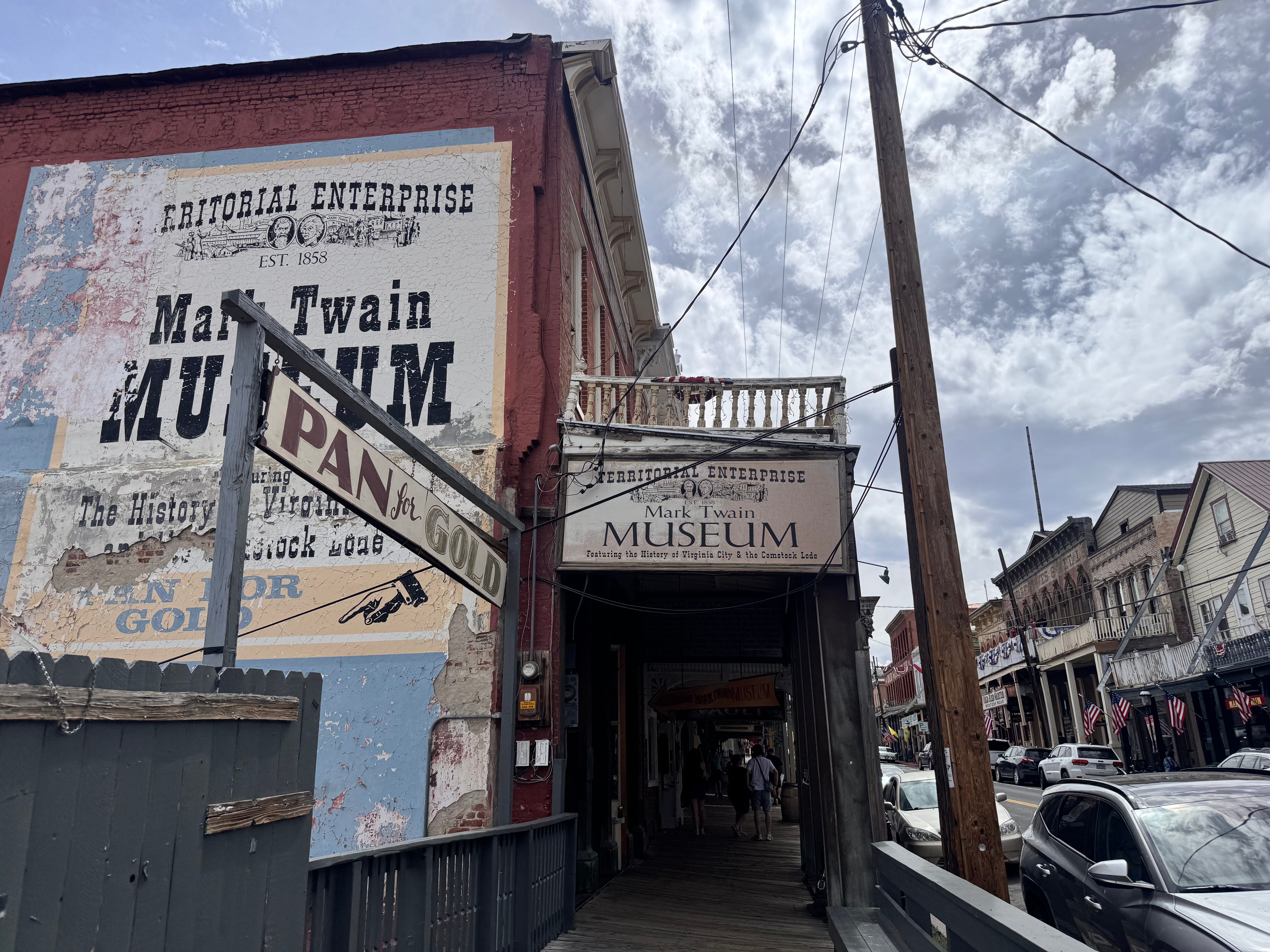
Last week I had the good fortune to visit the old Territorial Enterprise office in Virginia City, Nevada—known to literary posterity as the newspaper where Samuel Clemens cut his teeth as a reporter and eventually adopted his pen name Mark Twain.
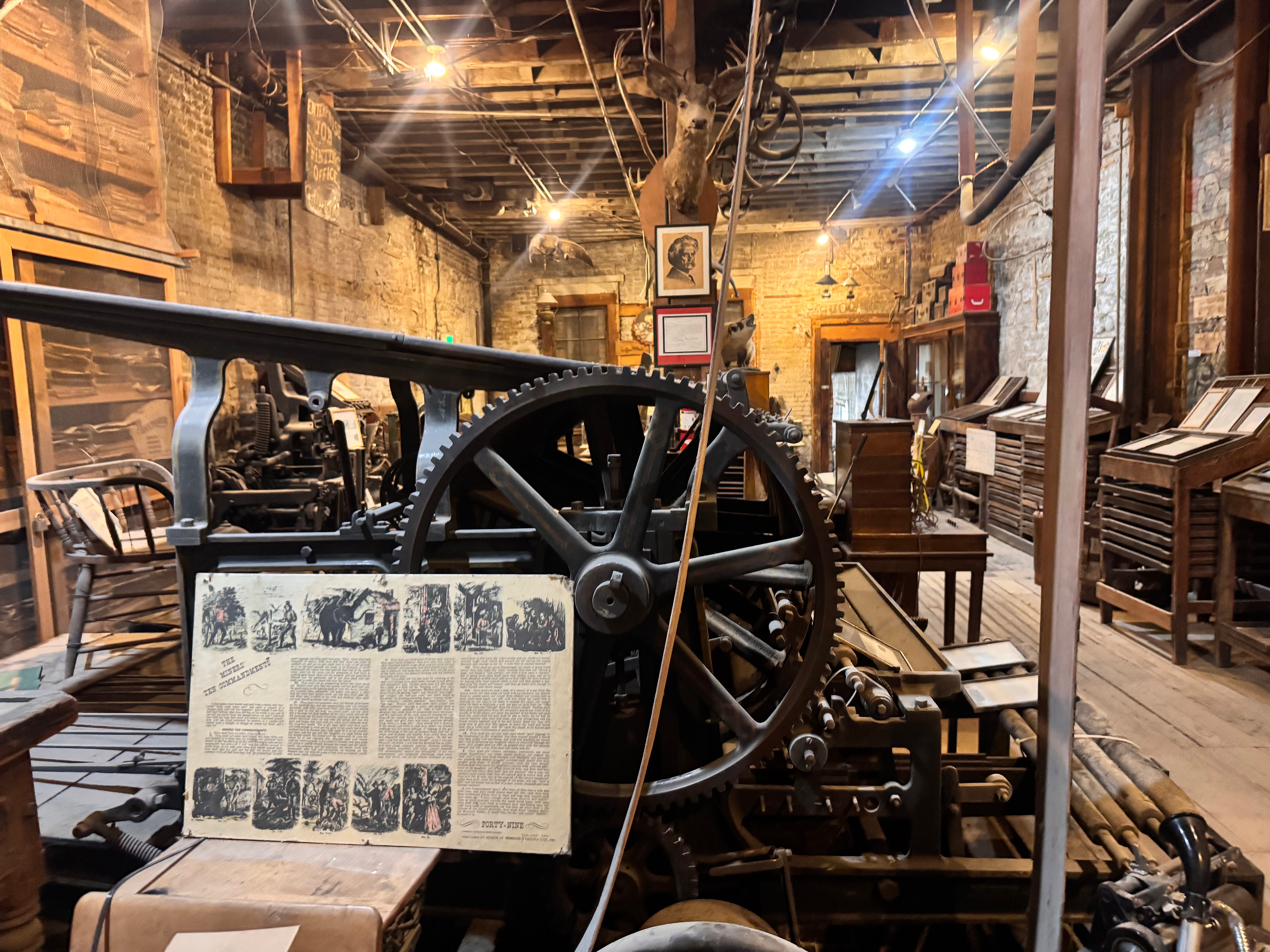
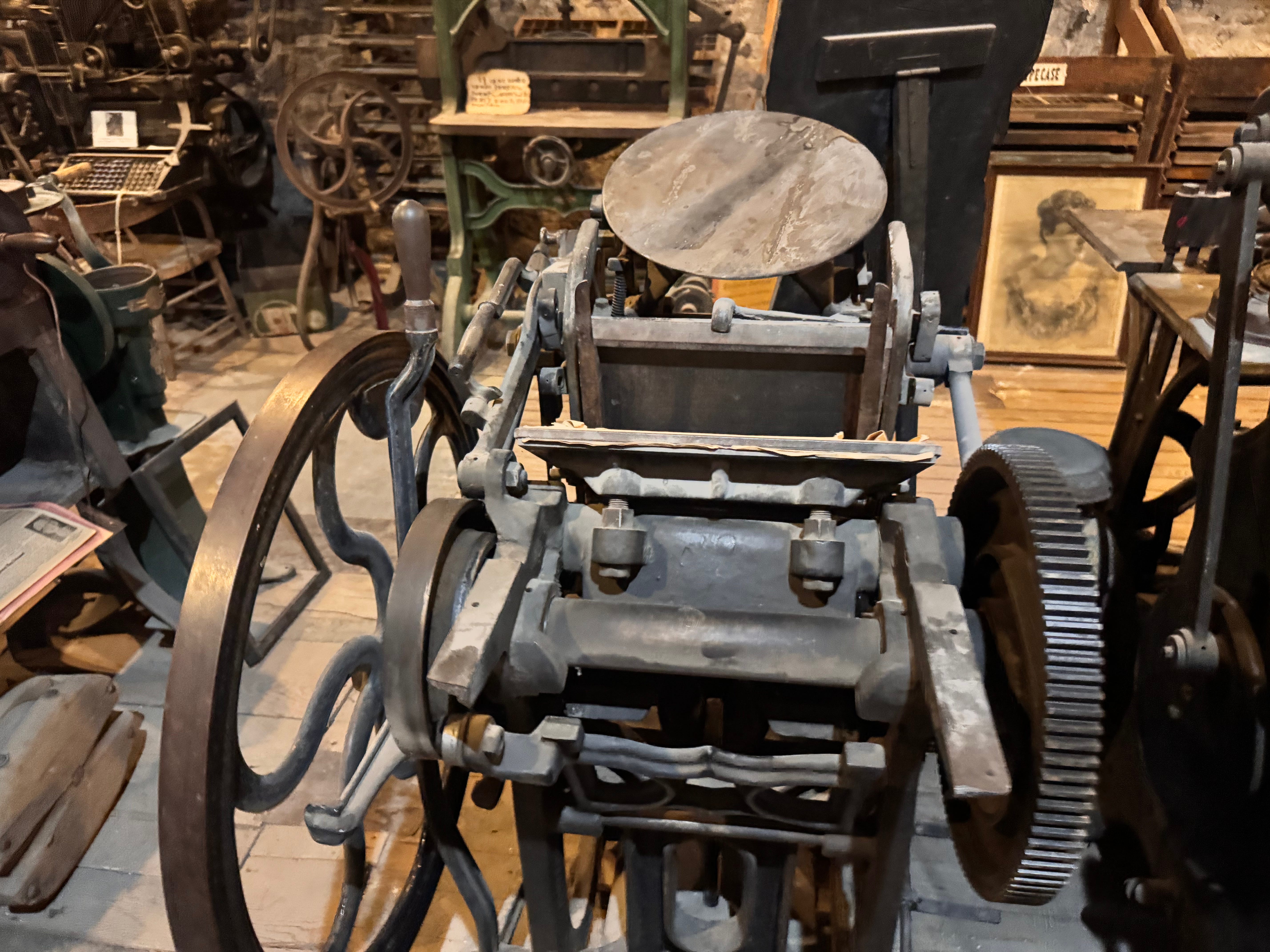
I first visited here back in 2009, and that trip helped spur my interest in researching the history of early American newspapers. At the time, though, I couldn’t make much sense of the mishmash of wrought iron machines strewn across the dusty old printshop floor. But now, having spent a good chunk of the last 15 years immersed in this world, I had a slightly better grasp of what I was looking at: that’s a first-generation Linotype, there’s the old Hoe press, the composing sticks, type cases… and the desk where Sam Clemens worked.
It was during his time at the Enterprise, in early 1863, that he first signed the name Mark Twain to a now-famous dispatch entitled “Letter from Carson City.”
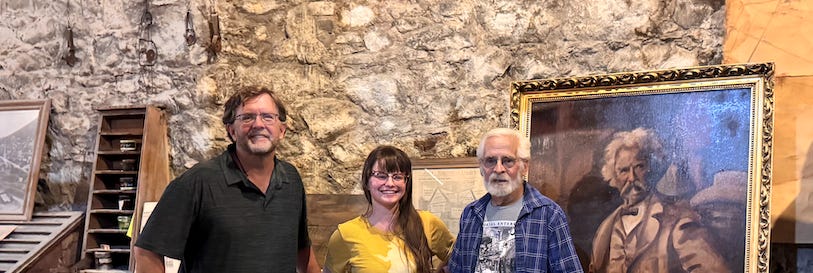
Alas, not many people get the opportunity to see this stuff these days. The museum has been closed for the last few years, but president Steven Saylor and local storyteller Taylor Hamby were kind enough to open it up and show me around for an afternoon.
The Territorial Enterprise had been in business for about four years by the time a 26-year-old Sam Clemens arrived on the scene, fresh from a failed attempt at striking it rich prospecting for silver. Publisher Joseph Goodman had picked up a used handpress in Sacramento and hauled it over the Sierra Nevada and past Lake Tahoe to the little desert town (which, according to local legend, was named Virginia City after a notorious old drunk who went by the name “Old Virginny,” who accidentally spilled his whiskey bottle and thereby decided to christen the place a city).
By the time Clemens arrived on the scene in 1862, the Enterprise had established itself as the premier newspaper of the American West. But publishing a newspaper out west was a very different undertaking from the staid city rooms and sleepy country presses east of the Mississippi.
On his first day on the job, Clemens noticed that every man in the printshop carried a revolver. Soon enough, he got one for himself, “in deference to popular sentiment.”
But the revolvers were not just for show. Newspapering in the Old West could be a singularly dangerous business.
When Wells Drury applied for a reporter’s job at Nevada’s Gold Hill News in 1876, its gruff, hard-drinking editor Alf Doten asked him a single interview question: “Can you shoot?” Drury had scarcely ever touched a gun and instead rattled off his journalistic credentials. Doten was unimpressed but gave him the job anyway. “You write what you please,” he told him. “Nobody censors it. But you must defend yourself.”
He wasn’t kidding. Editors flung insults at each other with shocking regularity, challenged rivals to duels, and occasionally settled their disagreements with gunfire. Goodman himself once shot a rival editor in the leg after the man insulted his prose style.
Virginia City in those days proved a treasure trove of journalistic raw material. Gunfights were a regular feature of town life, but so were operas, gambling houses, dancing girls, parades, and all kinds of other goings-on. Clemens, writing years later as Twain, recalled it as the “livest” town he had ever seen.
There were military companies, fire companies, brass bands, banks, hotels, theaters, hurdy-gurdy houses, wide-open gambling palaces, political pow-wows, civic processions, street fights, murders, inquests, riots, a whiskey mill every fifteen steps, a Board of Aldermen, a Mayor, a City Surveyor, a City Engineer, etc. . . . A dozen breweries and half a dozen jails and station-houses in full operation, and some talk of building a church.
Clemens’s first reporting assignment was notable only for the distinct lack of anything newsworthy happening. At his editor’s suggestion, he tried to fashion a story about an old hay wagon that had brought a load into town. It was a dreary business, until one evening he heard the sound of gunfire. A local desperado had just killed an innocent man in a saloon. Clemens rushed to the scene and “wrote up the murder with a hungry attention to details.”
Soon enough, he was writing regular dispatches from around town, covering the booming silver mines and finding all manner of Old West excitement to fill his columns. In one surviving article, Twain articulated the guiding editorial spirit of the Enterprise—one that might serve as a mission statement for any number of local newspapers even today:
To keep the universe thoroughly posted concerning murders and street fights, and balls, and theaters, and pack-trains, and churches, and lectures, and schoolhouses, and city military affairs and highway robberies, and Bible societies, and haywagons, and a thousand other things which it is in the province of local newspapers to keep track of and magnify into undue importance for the instruction of the readers of this daily newspaper.
Even on a slow day, Twain managed to find material to write about, and was not above embellishing the facts—or, in some cases, inventing them from scratch. The seemingly placid Enterprise office was, he later recalled, “a ghastly factory of slaughter, mutilation and general destruction in those days.”
Twain’s most notorious work of journalistic embellishment was a story entitled “The Petrified Man,” in which he reported that a corpse had been discovered in the mountains “as petrified as the rock around it,” and that a local judge issued a ruling against burying the man, as doing so would have required blasting him out of his resting place with dynamite.
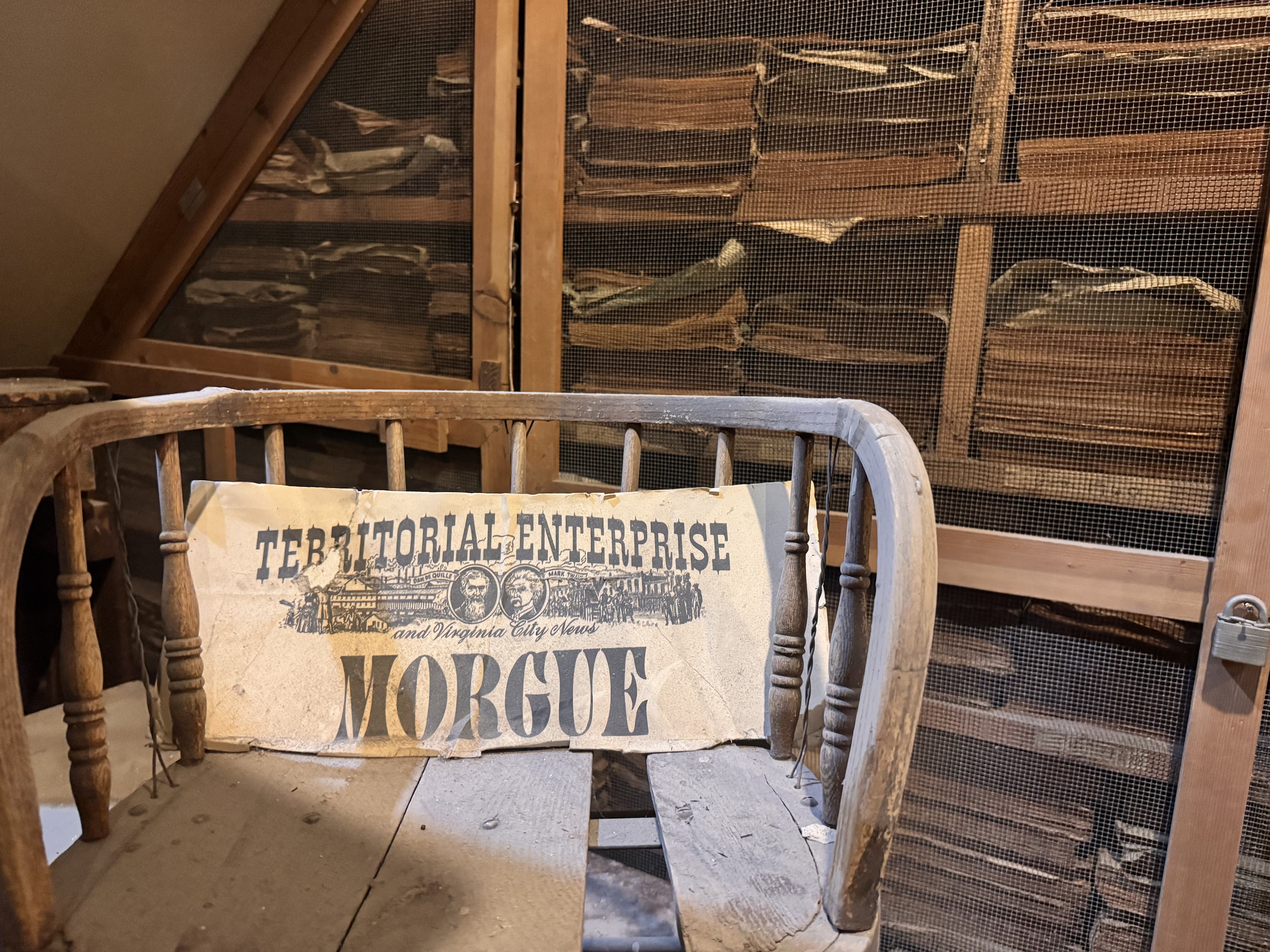
Twain later freely admitted that the story was “an unmitigated lie, made from whole cloth.” But many readers believed it anyway. The tale circulated quickly across the newspaper exchange networks and appeared in numerous other Nevada and California papers.
Discriminating readers might have noticed a clue to the story’s fictional provenance embedded in the text. Twain described the body as having been discovered resting in a sitting position, with “the right thumb resting against the side of the nose.” The petrified man was, quite literally, thumbing his nose at the reader.
Twain went on to pen other grand hoaxes for the paper, including “A Bloody Massacre Near Carson” and “The Great Landslide Case,” which also proved wildly popular on the exchanges. He later justified such editorial liberties on the grounds that “the public needed matters of thrilling interest for breakfast.”
But while Twain never intended these stories to be taken seriously, they were. After learning that a great number of readers had mistaken the “Bloody Massacre” story for real news, he published a retraction. Reflecting on the incident ten years later, he could not help marveling at the credulity of his readers.
“The idea that anybody could ever take my massacre for a genuine occurrence never once suggested itself to me,” he wrote, given that the story had been “hedged about” by obvious absurdities. But the experience taught him something he never forgot: readers confronted with a sufficiently exciting story tend not to linger over the dull details that might give the game away.
But despite the hoaxes and feuds and occasional forays into playing fast and loose with the facts, newspapers like the Enterprise fulfilled an essential civic mission. The local paper functioned simultaneously as town meeting, bulletin board, advertising network, political forum, entertainment medium and rumor mill.
When the Gold Hill News arrived in another Nevada mining town in 1863, one local woman reportedly greeted its editor with the words: “I am so glad that you’ve brought here your civilizer—your printing press.”
Civilization, however, was a relative concept.
The frontier press could be irresponsible, partisan, boosterish, occasionally dishonest and sometimes spectacularly rude. One Western editor candidly described his professional obligation as being willing to “toy with the truth in prophetic spirit for the good of the country or community in which he lives.”
In a place like Virginia City, putting a schoolhouse opening, a murder, a church lecture, a mining discovery and a hay wagon into the same publication did something important. It told readers: these things belong together because they happened to us.
That world was already beginning to disappear during Twain’s lifetime. By the end of the nineteenth century, telegraph networks and wire services were stitching formerly isolated papers into an increasingly national news system. Metropolitan newspapers employed increasingly specialized staffs, while reporting gradually adopted the more impersonal voice that would eventually coalesce into the mass media’s fabled “view from nowhere.”
Today, as we live through another age of media fragmentation, some of that old unruly spirit seems to be making a comeback. The sheer volume of stories, videos, and images gushing through our devices makes it dizzyingly difficult to sift truth from fiction, but we’re all still in the market for “matters of thrilling interest.” And, as I argue in the book, today’s fragmented media landscape in many ways bears a closer resemblance to the nineteenth century than the twentieth. I will spare you the painfully obvious “wild west” analogies ;)
Few of today’s social media influencers likely care much about what happened in these dusty Old West newsrooms 150 years ago, but the underlying problem hasn’t changed all that much.
We’re all still struggling to keep the universe thoroughly posted.
Such a great piece.. I love the connection between Twain’s unruly media world and the one we’re living in now.
I loved reading Mark Twain’s letter from Carson City. Thanks for attaching that! I felt like I was there. He was indeed a great writer, like you, Mr. Wright!