

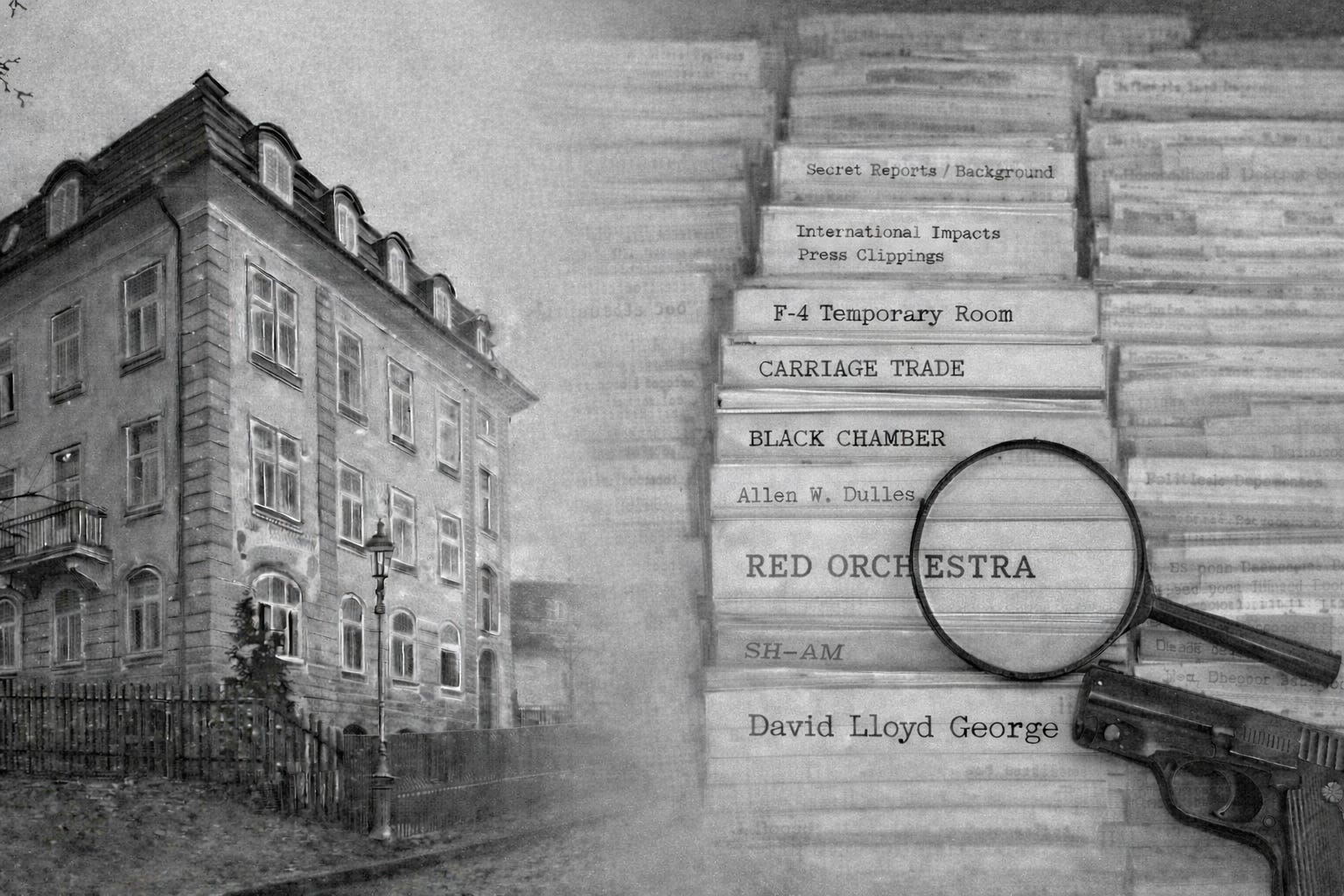
For years I’ve been fascinated by stories of history’s also-rans—the forgotten heroes and otherwise marginalized figures whose work has been left out of the historical canon, but nonetheless left a lasting imprint on the world.
In the past I’ve written about people like Paul Otlet, Wilhelm Ostwald, and Suzanne Briet—European information scientists whose legacies survive in the long shadow of better-known Anglo-American thinkers like Vannevar Bush, Doug Engelbart, and J.C.R. Licklider.
While researching the second edition of my first book, however, I came across an intriguing American who also played a major role in shaping the field of information science. But there was more to his story than that. The methods he developed were absorbed, almost wholesale, into the emerging American intelligence apparatus that became the CIA. Yet today he remains largely forgotten: Herbert Haviland Field.
The reasons for Field’s erasure are complex and multi-layered, but one major factor almost certainly involved his physical disabilities. He had a severe stutter, and was so nearsighted he could barely see. Despite showing remarkable early intellectual promise—earning his PhD at Harvard at age 23—he recognized early on that his limitations would make it difficult for him to pursue a conventional academic career.
In 1893, he startled his family by announcing that he would abandon his chosen field of zoology altogether. He had found a new calling, one that he could pursue from the comfort and privacy of his own desk: organizing the world’s information.
The problem of too much information
By the early 1890s, scholarly publishing had expanded so rapidly that many research disciplines seemed to be coming apart at the seams. A newly industrialized press and expanding communications networks fueled an explosion of journals and monographs worldwide, while catalogs, indexes, and bibliographies failed to keep pace. Scholars were missing critical connections, and at times outright duplicating each other’s work.
Field coined a new term to describe this conundrum: “the science information problem.”
Field was scarcely the only one to recognize the problem. Across Europe and the United States, a small coterie of thinkers had begun to treat “information” as a field of study unto itself: something that could be organized deliberately rather than accumulated haphazardly. Field studied the new numeric classification system developed by Melvil Dewey, and followed the ambitious international bibliographic scheme promoted by Paul Otlet and Henri La Fontaine.
Like Otlet, Field believed the real power of indexing techniques lay beneath the surface of individual texts. A single article might touch on several subjects. A well-constructed index could make those connections visible and usable, enabling scholars to make multi-dimensional connections between sources and findings.
International intrigues
But Field was more than just a bibliographer. He was also a student of government, and the emerging bureaucracies of information management that were becoming essential to the functioning of the modern nation-state.
Early in his career he had traveled to Russia to study the paper filing systems used by its vast bureaucracy. He examined card catalogs under development at the United States Department of Agriculture. In Paris, he consulted with Alphonse Bertillon, whose card-based system for managing criminal records demonstrated how classification could function across large populations.
Taken together, these encounters convinced Field that the future of knowledge lay less in books and journals than in the systems people used to extract information from them. He was a fervent believer in the hidden powers of index cards—the flat-file database technology of the day. They were standardized and portable, could be copied, sorted, and refiled as needed—unlocking all kinds of ontological possibilities.
With modest backing from two zoological societies and more substantial support from his father, Field began to imagine a new kind of bibliographic enterprise. Scholars would subscribe to a steady stream of index cards, mailed out every two weeks, each card describing a newly published piece of research. Subscribers would file the cards locally, integrating them into their own collections. Over time, these cabinets would form a loose but coordinated arrangement. Knowledge would be dispersed across many locations, but remain broadly aligned.
This point mattered to Field. Unlike Otlet, who envisioned a monumental central archive, Field believed no single institution could ever hope to keep pace with modern science. Understanding depended instead on coordination among many partial collections. Each subscriber would possess only a fragment of the whole picture, but together those fragments could add up to a unified whole.
Seeking international legitimacy, Field relocated to Paris and gave his enterprise a new name: the Concilium Bibliographicum. He lived alone and worked obsessively, racing to establish credibility before better-funded competitors like the Royal Society in London could claim the high ground.
Field hired professional catalogers and invested heavily in infrastructure. As his subscription business grew, he purchased printing presses, employed typesetters, and installed an automated card-cutting machine. By 1898, the Concilium was producing more than 1.6 million cards every year. He built an imposing headquarters in Paris, an information palace meant to convey permanence and authority.
For a brief period, the project thrived. Major institutions like the Smithsonian, Harvard, Yale, Princeton, the University of Michigan, and the Library of Congress all subscribed to the service. But the scope of the problem continued to expand. By the turn of the century, the sheer velocity of published information was continuing to spiral out of control. The zoological literature alone demanded tens of thousands of new cards annually. Field’s production costs rose quickly. Revenue did not.
By 1908, subscription growth had stalled. Appeals for institutional funding failed. A large personal loan only deepened Field’s losses. Exhausted and increasingly unstable, he laid off his remaining staff and relinquished control of the Concilium. The institution survived under new leadership but never recovered its momentum.
Most histories of Field’s work end here. He appears as a tragic figure, a gifted intellectual unable to bring his ideas to fruition. But the man went on to an intriguing—and even less known—second act.
Entering the labyrinth
When World War I broke out, the idealistic Field began working with a Quaker relief agency, ferrying food and medicine between countries and soaking up all kinds of information about politics and daily life in the combatant countries.
It was during this time that he made the acquaintance of a young State Department apparatchik named Allen Dulles—the spymaster who would go on to become the driving force in creating the modern CIA.
Dulles quickly came to see Field as an unusually effective intelligence asset. Field approached political instability, technological developments, and diplomatic signaling much as he had once approached the scientific literature: as a mass of heterogeneous data points to be standardized, cross-referenced, and selectively circulated.
He supplied intelligence on civil war and famine in Bavaria, Germany’s emerging gas-warfare capabilities, and Austria’s openness to peace negotiations—material that required not just access, but synthesis.He fed Dulles intelligence on the civil war and famine in Bavaria, Germany’s emerging gas warfare technologies, and critical information on Austria’s receptivity to making peace with the Allies.
Field made such an impression with the State Department that he was eventually invited to work on the Treaty of Versailles, and help plan out the formation of the League of Nations (a project that brought him back into the orbit of his intellectual hero Paul Otlet). His diligent efforts to shape the post-war political landscape raised his visibility with the U.S. government, eventually bringing him into direct contact with Woodrow Wilson—who he recognized as a kindred spirit in their shared commitment to the emerging ideal of internationalism.
The same techniques Field had developed in building the Concilium—abstraction, cross-referencing, selective circulation—proved invaluable in shaping his intelligence work. He had mastered the ability to compare and connect discrete fragments of knowledge, detect hidden patterns, and make that information usable.
As Colin Burke observes, such techniques were central to the formation of the modern bureaucratic state. Index cards, filing systems, documentation standards, and clerical labor formed the hidden machinery of governance. Intelligence services did not invent these tools, but they perfected them. And Field played a central—and largely unheralded role—in developing these core mechanisms that would enable the modern intelligence agency to thrive in the decades to come.
World War I delivered the final blow to the Concilium, which had already been struggling to survive the accelerating scale of scientific publishing. Postwar efforts to revive the enterprise failed, and Field himself died in 1919, in the wake of the influenza pandemic that swept Europe at the end of the war.
As historian Colin Burke observes, these techniques—indexing, abstraction, cross-referencing, controlled circulation—were central to the rise of the modern bureaucratic state. Intelligence agencies did not invent this machinery, but they refined it, weaponized it, and scaled it.
Field’s legacy continued through the astonishingly varied career of his son, Noel—whose life would intersect with diplomacy, Soviet intelligence, and the emerging American intelligence apparatus (thanks in part to the family’s close connection to Dulles). Burke uses Noel’s trajectory to trace a broader continuity between early systems of knowledge organization and the bureaucratic, intelligence-driven state that emerged in the twentieth century.
Long before anyone imagined the possibility of intelligence as “artificial,” Field was working towards a grand vision of federating knowledge and, one might argue, a generative system. Field did not solve the problem of too much information—no one has—but he recognized its strategic value, and left a lasting legacy that is deeply entrenched but largely hidden in the shadows of the modern bureaucratic state.
Further reading
Colin Burke’s Information and Intrigue is the definitive biography of Field, and a great read at that.
This essay is adapted in part from the second edition of my first book, Informatica.
Fascinating! Thanks for circulating this knowledge—